
In accounting, liability accounts are used to record debts or obligations that a company owes to others. Fixed assets such as buildings and vehicles are also considered asset accounts. These assets are typically long-term investments that a company expects to use for debits and credits accounting several years.
- Examples include sales tax you have collected and payroll tax.
- If the totals do not match, review your entries to find and correct any errors.
- By recording both aspects of the transaction, double-entry bookkeeping provides a complete picture of how the purchase affects the company’s financial position.
- By analyzing equity accounts, investors and analysts can gain valuable insights into the financial health of a company.
- Assets are resources of value that your business owns or controls.
Creating a General Ledger
So, you take out a bank loan payable to the tune of $1,000 to buy the furniture. At FreshBooks, we help you protect your profits and time with a powerful bookkeeping service. By integrating with Bench, we help you track every dollar you spend while Bench handles bookkeeping and tax preparation. With us, you’ll know your business so you can grow your business. They let us buy things that we don’t have the immediate funds to purchase.
How Are Debits and Credits Recorded?

But the transaction also decreases your inventory (assets) and increases the cost of goods sold (expense) accounts. So, you must also credit the assets (inventory) and debit the expenses (COGS). The most important thing to remember is that when you’re recording journal entries, your total debits must equal your total credits. As long as you ensure your debits and credits are equal, your books will be in balance. In accounting, a debit is an entry made on the left side of an account, while a https://kutenda.ae/depreciation-amortization/ credit is an entry made on the right side.
- You’ll know if you need to use a debit or credit because the equation must stay in balance.
- Debits and credits are used in each journal entry, and they determine where a particular dollar amount is posted in the entry.
- If there’s one piece of accounting jargon that trips people up the most, it’s “debits and credits.”
- This account is used to track the company’s short-term debts and is typically paid within a few weeks or months.
- The double-entry bookkeeping system is built on the principle that every financial transaction affects at least 2 accounts.
Testing Your Understanding

For example, when a company sells goods on credit, the revenue account is credited, and the accounts receivable account is debited. Overall, understanding the accounting equation is crucial for anyone involved in accounting or finance. By keeping this equation in mind, companies can ensure that their financial records are accurate and up-to-date, which is essential for making informed business decisions. Overall, debits and credits are essential tools for anyone involved in finances or financial analysis. In accounting, a contra account is an account that is used to offset another account.
- Additionally, there may be an additional fee if you choose to get the money delivered to you.
- When credits to revenue run ahead of credits to liabilities and debits to expenses, equity grows.
- You can dispute a transaction either through Online Banking (steps provided below), by calling PNC or going to your local PNC branch.
- In summary, equity accounts are a critical component of accounting as they represent the residual interest in the assets of an entity after deducting liabilities.
- In summary, asset accounts are a crucial component of a company’s financial health.
- However, back when people kept their accounting records in paper ledgers, they would write out transactions, always placing debits on the left and credits on the right.
Recording Sales in a Credit Transaction

Some people may prefer to use a debit or credit card over cash for foreign transactions. Debit cards with no or minimal foreign transaction fees may be a good option. There may also be conversion fees, but you may potentially avoid these fees if the merchant allows you to select to pay in the local currency. Business operations often involve providing goods or services before receiving payment, which is known as selling on account.

Learn how to build, read, and use financial statements for your business so you can make more informed decisions. Retained earnings are the accumulated profits of a company that are not distributed as dividends to shareholders. These earnings are reinvested in the business to fund growth and expansion. Retained earnings are reported on the balance sheet under shareholders’ equity. The following cheat sheet summarizes how debits and credits relate to Balance Sheet and Income Statement items. Equity is what is left after a business uses its assets to pay off its liabilities.
Revenue Accounts
Also, learn about the common tricks scammers are using to help you stay one step ahead of them. If you see unauthorized charges or believe your account was compromised contact us right away to report fraud. Try Xero accounting software for free and see how easy accurate accounting can be. Liabilities are amounts your business owes but has not yet paid. Examples include sales tax you have collected and payroll tax.
- For example, a business recorded monthly equipment depreciation amounting to $400.
- Business operations often involve providing goods or services before receiving payment, which is known as selling on account.
- This equation must always balance, meaning that the total value of a company’s assets must always equal the total value of its liabilities and equity.
- Much of the work performed by a professional accountant relates to the design, implementation, and evaluation of properly functioning control systems.
- By having a clear view of your cash flow with detailed financial records, you can budget more easily, track your profits and identify strategic ways to grow.
- Debits increase your expense accounts because they represent money going out.
- Imagine if a real business tried to keep up with its affairs this way!
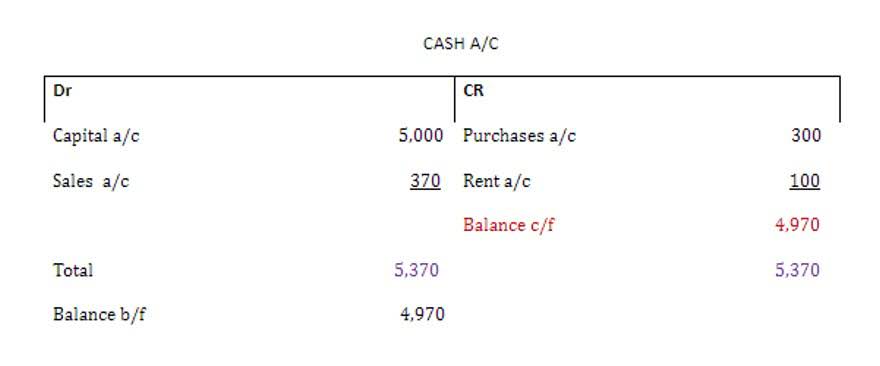
Make deposits and withdrawals at the ATM with your business debit card. Therevenue and expenses accounts are always cleared at the end of afinancial year so they start the new year with a zero balance. Bear in https://www.bookstime.com/ mind that each of the debits and credits to Cash shown in the preceding illustration will have some offsetting effect on another account. For instance, the $10,000 debit on January 2 would be offset by a $10,000 credit to Accounts Receivable.